
How to Choose a Padel Racket: Round, Teardrop or Diamond?
Round, teardrop or diamond? How padel racket shape, weight, face material and core affect your game, and how to choose the right racket for your level.
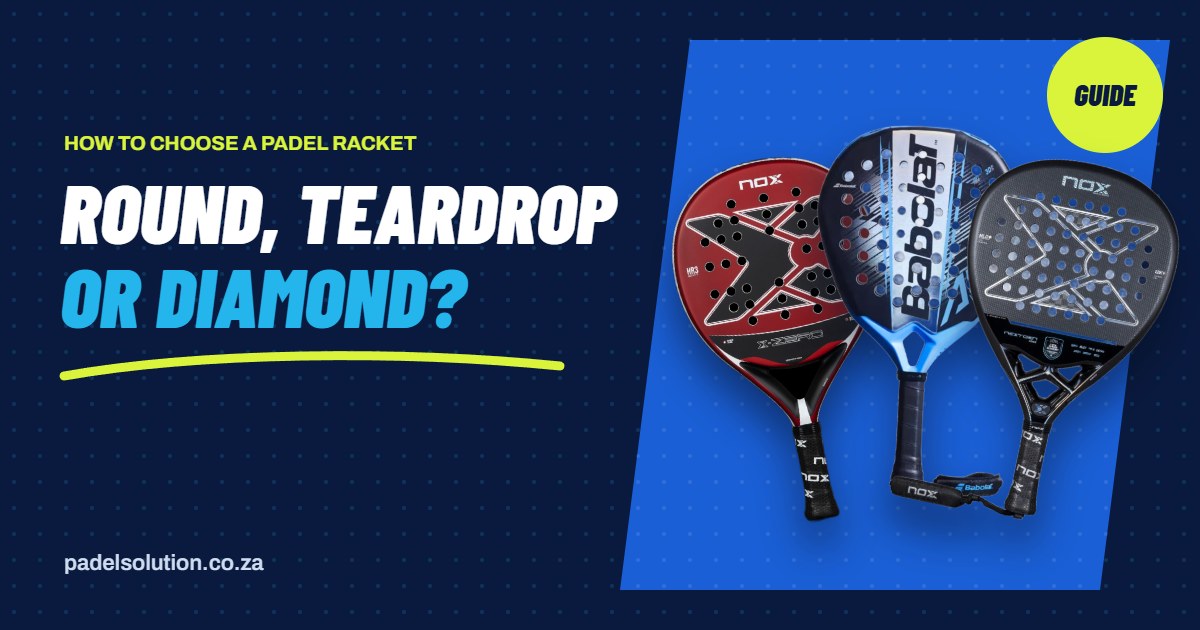
Walk into any padel club in South Africa and you will hear the same question at the bar after a match: which racket should I buy? The honest answer is that the best padel racket is the one that suits how you play right now, not the one your favourite pro uses. This guide explains the three racket shapes, what balance, weight and face material actually change, and how to match all of it to your level so you buy once and buy right.
Short on time? Take our 60-second Racket Finder and we will narrow the range down for you.
The three padel racket shapes
Every padel racket falls into one of three head shapes. The shape decides where the sweet spot sits and how the weight is distributed, and that has a bigger effect on how the racket feels than anything else.
Round: control and comfort
A round racket has a large sweet spot in the centre of the face and its weight sits low, close to your hand. That makes it forgiving on mishits, easy to manoeuvre at the net and kind on your arm. Round rackets are the natural choice for new players, defensive players and anyone coming back from an elbow or shoulder niggle.
Choose round if: you are in your first year of padel, you like to play from the back of the court, or you want consistency over raw power.
Teardrop: the all-rounder
The teardrop sits between the other two. The sweet spot moves slightly higher up the face and the balance is medium, so you get a little more punch on smashes and volleys without giving up too much control. For most improving club players, a teardrop is the sweet spot.
Choose teardrop if: you play a few times a week, you are comfortable at the net and the back of the court, and you want room to grow.
Diamond: power
A diamond racket carries its weight high in the head with a small sweet spot near the top. When you connect, the ball flies, which is why aggressive players and smash specialists love them. The trade-off is that mishits are punished and the extra head weight puts more load on your wrist and elbow.
Choose diamond if: you have solid technique, you play an attacking game, and you finish points at the net.
Shape at a glance
| Round | Teardrop | Diamond | |
|---|---|---|---|
| Sweet spot | Large, central | Medium, mid-high | Small, high |
| Balance | Low (towards the handle) | Medium | High (towards the head) |
| Strength | Control | All-round | Power |
| Best for | Beginners, defenders | Improving club players | Advanced, attacking players |
| Arm friendliness | Highest | Good | Lowest |
Weight: why a few grams matter
Most adult padel rackets weigh between 340 g and 375 g. A lighter racket (around 340 g to 355 g) is quicker in your hand and easier on your arm, which suits beginners, juniors and many women players. A heavier racket (360 g and up) feels more stable on impact and adds power, but it tires your arm faster over a long match.
If you are unsure, stay on the lighter side. You can always add weight with an overgrip or a frame protector, but you cannot take it away.
Face material: fibreglass or carbon?
The face of the racket is the surface that strikes the ball. It is usually made from fibreglass, carbon fibre or a blend of the two.
- Fibreglass is softer and more flexible. It gives you a comfortable feel, helps the ball come off the face with little effort and is usually found on more affordable rackets.
- Carbon is stiffer and more durable. It gives you precision and power, but you have to generate more of the pace yourself. You will see it described as 3K, 12K, 18K or 24K, which refers to the number of carbon filaments in each strand.
Newer players generally do better with fibreglass or a soft carbon blend. Experienced players often prefer the crisp response of carbon.
The core: soft or hard EVA
Inside the racket is a foam core, usually EVA rubber. A soft core absorbs more vibration and launches the ball more easily at slow speeds, which suits beginners and players with sore arms. A hard core gives more control and power at high speeds, which suits strong hitters. Many modern rackets use a medium or hybrid core to get some of both.
Match the racket to your level
New to padel
Choose a round racket, around 340 g to 360 g, with a fibreglass face and a soft core. It will forgive mistakes while you learn the walls. See our guide to the best padel rackets for beginners.
Social and club players
A teardrop with a carbon or hybrid face is the most popular choice here. It gives you enough control for long rallies and enough punch to finish at the net.
Competitive players
If your technique is solid and you play an attacking game, a diamond or a power-focused teardrop with a carbon face and a harder core will reward you. Keep an eye on your arm and do not jump straight to the heaviest option.
A note on your arm
Padel elbow is real. If you feel pain on the outside of the elbow after playing, a heavy, head-heavy or very stiff racket is often part of the problem. Moving to a lighter, lower-balance racket with a softer core, and using a fresh grip, can make a big difference. Persistent pain is worth a visit to a physio.
Still not sure?
That is what we are here for. Use the Racket Finder, browse every racket by shape on our padel rackets page, or get in touch and tell us how you play. We deliver nationwide, and orders over R1,500 ship free.
Keep reading
The Best 2027 Padel Rackets: What’s New From Nox, Bullpadel and Babolat
What is new in the 2027 padel rackets from Nox, Bullpadel and Babolat, who each one suits, and whether to…
Padel Bags: How to Choose the Right One (South Africa Guide)
Racket bag, backpack or cover? How to choose a padel bag, why a thermal compartment matters, and the bags we…

Best Padel Shoes in South Africa: A Buying Guide for 2026
Sole patterns, fit, support and when to replace them, plus the padel shoes we stock in South Africa.
